Hineni! Isaiah’s Call and Ours
Shalom in His grace.
We live in turbulent times, which is why it is so important that we put our trust in the Lord and make ourselves available for service. We have an inspiring example of this in the ancient Hebrew prophet Isaiah. There is no place where the character and commitment of the prophet are more clearly seen than when God Himself called him to ministry (Isaiah 6).
Isaiah’s call came around 740 BCE, when the kingdom of Judah stood at a crossroads. King Uzziah, who had reigned for fifty-two years, was dead. With his passing came uncertainty, fear, and the looming shadow of Assyrian aggression on the horizon.
For Isaiah, this was not just a national crisis—it was personal. He had lived and prophesied during Uzziah’s reign, warning of God’s judgment upon a people whose hearts had grown cold. Now, as political stability crumbled, so did any illusion that his words had made a difference. As Isaiah described it, God was about to trample His vineyard and lay it waste (Isaiah 5:5–6).
In this moment of profound despair and seeming failure, God revealed Himself to Isaiah in a way that would forever transform the prophet’s life.
A Vision of Glory
Isaiah portrayed his extraordinary divine encounter as follows: “In the year of King Uzziah’s death I saw the Lord sitting on a throne, lofty and exalted, with the train of His robe filling the temple” (Isaiah 6:1).
Amid earthly loss and uncertainty, Isaiah was granted a glimpse of the true King who would never die, seated on His eternal throne, lifted above all others in the heavens.
The terms used to describe God’s posture are “high and lifted up,” which also match the prophet’s description of the Messiah in Isaiah 52:13, “Behold, My servant will prosper, He will be high and lifted up and greatly exalted.” These words offer a further hint of the divine nature of the coming Servant of the Lord.
The imagery is striking as the train of God’s robe filled the entire Temple. This vision provides our first glimpse into the heart of Isaiah’s message—amid human frailty and failing kingdoms, God’s sovereign rule remains unshaken and all-encompassing.
Above this throne were the seraphim, fiery angelic beings whose very name recalls the “fiery serpents” of Israel’s wilderness wanderings (Numbers 21:4–9). Their thunderous chorus echoed through the Temple, “Holy, Holy, Holy, is the Lord of hosts, the whole earth is full of His glory” (Isaiah 6:3).
The Hebrew word for “holy” (kadosh) means set apart. Three times, the seraphim declared God’s utter otherness—His complete separation from sin and creation. This repetition is not mere poetry but a profound expression of God’s triune nature, although Isaiah himself may not have fully comprehended this mystery. As the seraphim proclaimed God’s holiness, the very foundations of the Temple thresholds trembled, and smoke filled the sanctuary.
The Cleansing of a Prophet
In the presence of this overwhelming holiness, Isaiah could only see one thing clearly—his own unworthiness, “Woe is me, for I am ruined! Because I am a man of unclean lips, and I live among a people of unclean lips; for my eyes have seen the King, the Lord of hosts” (Isaiah 6:5). The Hebrew word for “ruined” (damah) means utterly destroyed. Isaiah recognized that his prophetic lips were unclean (tamey), the same term used throughout Leviticus to describe ritual impurity.
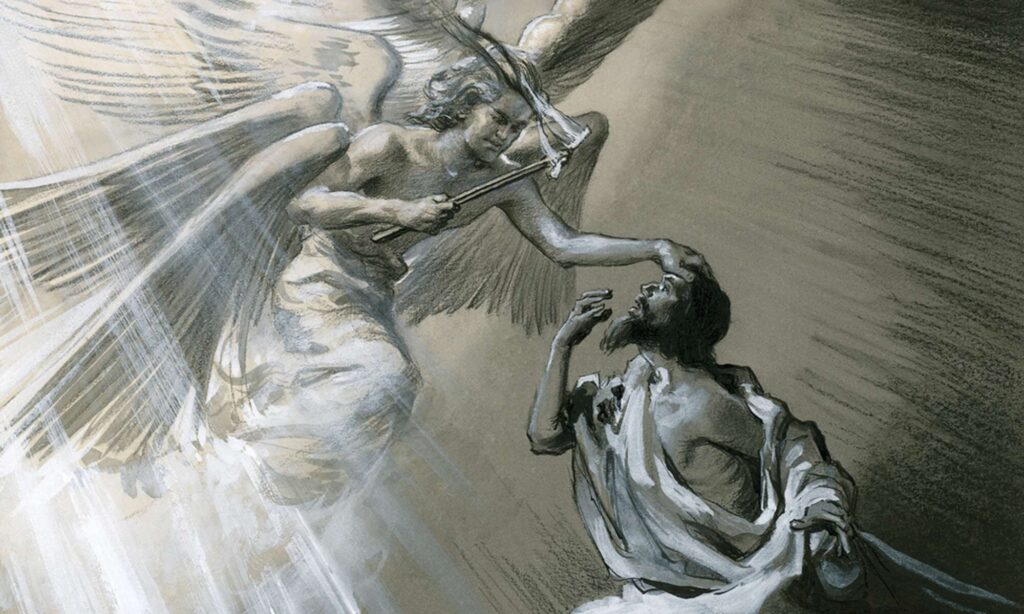
Isaiah may have wondered how a man with unclean lips and an unclean heart could speak God’s holy word. How could he condemn Israel’s sin when he himself was so deeply flawed? Yet, God’s response to Isaiah’s confession reveals the core of the gospel message:
Then one of the seraphim flew to me [Isaiah] with a burning coal in his hand, which he had taken from the altar with tongs. He touched my mouth with it and said, “Behold, this has touched your lips; and your iniquity is taken away and your sin is forgiven.” (Isaiah 6:6–7)

The coal was not just any coal, but one taken from the altar of sacrifice—drenched in the blood of atonement. The seraph’s touch did not just cleanse Isaiah’s lips for prophetic speech; it provided comprehensive forgiveness. Isaiah’s iniquity was taken away and his sin atoned for by the shed blood of the sacrifice (Leviticus 17:11).
Again, we see a foreshadowing of the Messiah. Just as Isaiah received cleansing through sacrificial blood, we receive forgiveness through the ultimate sacrifice of Yeshua (Jesus). Additionally, like Isaiah, our cleansing is not just a one-time event from years ago but a daily reality that enables us to be intimate with God and prepares us for service.
Saying Yes to God
Encountering God’s holiness and experiencing His cleansing grace positioned Isaiah to hear God’s call: “Then I heard the voice of the Lord, saying, ‘Whom shall I send, and who will go for Us?’ Then I said, ‘Here am I. Send me!’” (Isaiah 6:8).
The Hebrew meaning of the English phrase “Here am I” (hineni) is far more than a statement of physical presence. It is a declaration of complete availability and readiness to follow orders. Throughout Scripture, this response marks moments of profound encounter with God: Abraham said, “Hineni!” when God called him to sacrifice Isaac (Genesis 22:1); Moses said it when God spoke from the burning bush (Exodus 3:4); and Samuel said it when God called him as a boy in the Temple (1 Samuel 3:4).
Each of these instances represented a turning point—a moment when ordinary people made themselves fully available to an extraordinary God.
The Challenge of Faith
What makes Isaiah’s story so remarkable is what happened after he said, “Hineni.” Isaiah received perhaps the most discouraging commission in Scripture:
Go, and tell this people: “Keep on listening, but do not perceive; keep on looking, but do not understand.” Render the hearts of this people insensitive, their ears dull, and their eyes dim, otherwise they might see with their eyes, hear with their ears, understand with their hearts, and return and be healed. (Isaiah 6:9–10)
God was essentially telling Isaiah he would preach, but the people would not listen, and his preaching would make their hearts harder. No wonder Isaiah responded with the anguished question: “Lord, how long?” The answer was equally devastating: “Until cities are devastated and without inhabitant, houses are without people and the land is utterly desolate” (Isaiah 6:11).
The Hebrew prophet teaches us some great lessons in evangelistic patience, which is what many of us who serve with Chosen People Ministries have learned. We know that the day is coming when the Lord will turn the hearts of the Jewish nation to Jesus (Romans 11:25–29), even though we are eager and pray for our Jewish people to come to know their Messiah right now.
The Promise of the Remnant
Even amid this dire commissioning, God offered Isaiah a glimmer of hope about a faithful remnant, “Yet there will be a tenth portion in it, and it will again be subject to burning, like a terebinth or an oak whose stump remains when it is felled. The holy seed is its stump” (Isaiah 6:13).
This doctrine of a remnant runs throughout Scripture. The prophet predicts that even though Israel might be cut down like a tree, the stump—a faithful remnant—would remain, preserving the possibility of new growth. The apostle Paul would also later write, “In the same way then, there has also come to be at the present time a remnant according to God’s gracious choice” (Romans 11:5).
This remnant doctrine allows us to redefine success in evangelism. We are called to faithfulness, not visible results. We proclaim the gospel to all, knowing some will reject it while others—the remnant God has prepared—will receive it. The Lord has called us to faithfully proclaim the good news and let Him bring the good result!
Our Hineni Moment
What does Isaiah’s experience mean for us today? Like him, we live in uncertain times. Like him, we may feel our witness falls on deaf ears. Like him, we are painfully aware of our own unworthiness.
Yet Isaiah’s vision offers us hope. The same commission—difficult though it may be—comes with the same promise of a remnant who will believe.
Therefore, knowing His forgiveness and in obedience to His call:
- We preach whether people respond positively or not.
- We preach until the opportunity is no longer available.
- We preach, confident in God’s promise to preserve a faithful remnant for Yeshua.
We do not measure our success by visible results but by our faithfulness to the gospel. Our motivation comes not from confidence in our own abilities but from a vision of God’s glory and grace through Jesus.
Are we ready to say hineni—to be available to God and to serve Him in bringing the message of Yeshua to the Jew first and also to the Gentiles (Romans 1:16)? May we, like Isaiah, be transformed by a vision of God’s holiness, cleansed by His grace, and compelled by His call to say with sincere hearts, “Hineni, send me.”
Thank you for your love, faithful support, and prayers for our global staff who call on the Lord for His holy purposes while reaching Jewish people for the Messiah.
Your brother,

Mitch