Dear Friend,
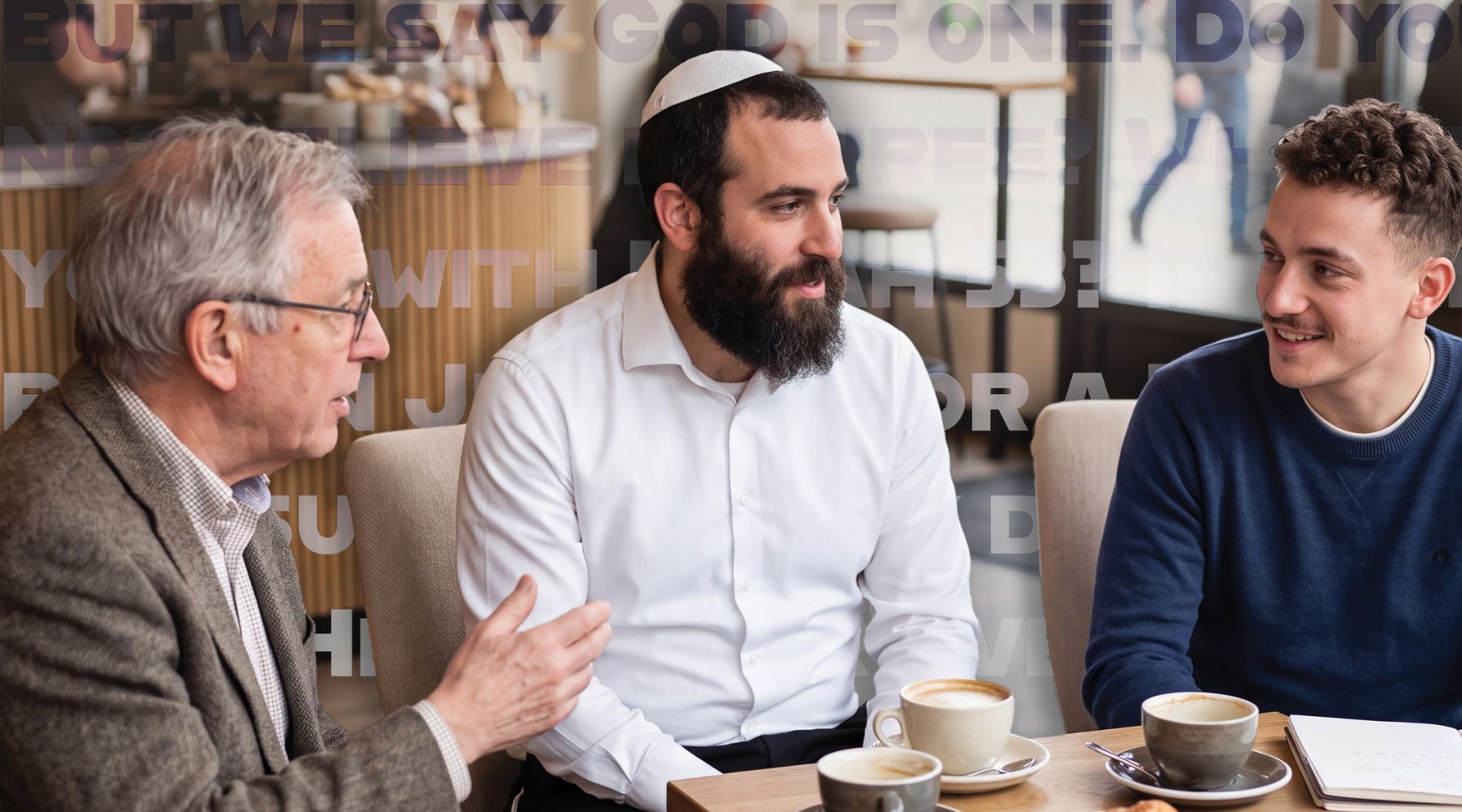
I hope you enjoy the following dialogue! However, Michael and David are not actual individuals. They are composites. I have stitched Michael and David together from fifty-plus years of conversations with cousins, classmates, congregants’ families, Brooklyn neighbors, and many others. Their questions are real, and I have been asked versions of these questions many times over many years.
David is more Orthodox. He prays three times a day, reads the Torah on his subway commute, and prays for the coming of Mashiach (Messiah) every morning with real expectation. Michael grew up Reform, had a bar mitzvah, remembers some Hebrew, married a woman who is not Jewish, and would call himself “culturally Jewish” but not “religious.”
I am a Jewish believer in Yeshua, which is why this conversation is so important to me. It is realistic, and if you are someone who has not yet become a follower of Jesus the Messiah, then it is my hope to have you be part of the dialogue. Whether you identify with Michael, David, or me, I hope you will give it some serious thought and that it will help on your faith journey today.
In the pages that follow, I want to walk you through eleven questions that come up almost every time I have this conversation with my fellow Jewish family and friends. I divided it into two parts for easier reading. If you are a non-Jewish Christian reader,
I pray the conversation will give you a clearer picture of where many Jewish people stand in relation to Jesus; and if you are a David, a Michael, or someone in between, I hope you will find the dialogue fun and fruitful! If you know a David or Michael, then I hope it will give you a better understanding of the issues, a deeper love for the Davids and the Michaels in your own life, and energize your prayers for my Jewish people.
Feel free to use the questions as a guide for your conversations with friends as well!
In Messiah,

“What are you even waiting for?”
Michael asks this of David, not of me, and I have learned to stay quiet when the question is not to me.
David answers the way our tradition usually responds. Messiah is a human descendant of David who will gather the exiles, rebuild the Temple, establish justice among the nations, and usher in an era when the knowledge of God fills the earth. He is not embarrassed by any of it; he prays for it daily.
Michael shrugs, not dismissively—he means it kindly. He says he does not really wait for anything. Being Jewish, for him, means memory, family, humor, a way of arguing, and showing up for people, not a coming king.
Pew’s 2020 study of Jewish Americans found that 32 percent of Jewish adults identify with no branch of Judaism at all, a group that substantially overlaps with the 27 percent who describe themselves as Jews of no religion, having Jewish ethnicity, culture, or family, but not faith.1
Michael is not the fringe. He sits closer to the center of gravity than David does. David represents only 9 percent. Michael holds the more common viewpoints. Yet, without stereotyping, all three of us really like a good bagel! So, in this way, we are all three very similar!

“So, why is it that you do not believe Jesus is the Messiah?”
I ask this one gently of both, but let David go first, as he would articulate the more traditional response and give us more to discuss.
His objections are not what we might expect: the Gospels are not historically correct, the resurrection is unfounded, Messianic prophecy is misinterpreted. These would be the usual suspects. But David is working within a Jewish worldview and has a different set of objections. His answer comes from a more traditionally Jewish set of Messianic expectations that have not been fulfilled.
He begins by saying that if the Messiah had come, the world would have changed dramatically. But it has not changed. There is no worldwide peace, no rebuilt Temple, no nations streaming to Zion. Within a generation of Yeshua’s death, Rome destroyed the Temple and the exile deepened. From where David sits, history tested the claim, and it failed.
I take that seriously, and I say so before anything else. It is a real objection, not a shallow one, and the Christian answer—that Messiah came first to atone and will return to reign—is my answer. But remember, David does not read the New Testament and bases his expectations on the Hebrew Scriptures as traditionally interpreted by the Jewish sages. I tell David that I agree with him: the world is nowhere near at peace, but that there are other Messianic expectations in the Bible that he might not know of. Since it would take much longer to explain why Messiah was to come twice, I let this go for a later moment!
Michael’s answer is completely different. He has no theological objection to Yeshua or to anything biblical or religious. He simply said that “this is not what we do.” Jesus is on the other side of a line someone drew long ago, and that line has more to do with belonging than faith.
Two men, one question, two sets of obstacles. Whatever answers I had for David proved useless for Michael. His answer was more like my dad’s, who once told me, “Son, it is not Jesus that gives me trouble; I am just not sure I believe in God.”
“How did you come to believe this?”
For years, I heard this question and responded defensively, believing I had to prove I am still Jewish in some way. But this is not always the case, as many Jewish people, especially those who know me, are curious. Michael simply wondered what happened to me; David wanted to understand how a Jewish person, who grew up in the Jewish faith, could turn what he would view as 180 degrees to follow the founder of another religion.
So, I told them my story rather than inciting an argument, because that is what they asked me to do.
I explained that I did not convert to a different religion. I did not stop being the grandson of Jewish immigrants from Eastern Europe. What changed is that I came to believe the Messiah of Israel had already come and that His early followers were all Jewish, kept the Jewish holidays, and prayed in the Temple. I tried to explain, through my own story, that there are thousands of Jewish people who believe in Jesus, and that the movement is growing today—even in Israel.
David listens carefully and asks a few good questions. He believes me when I tell him that I am not suggesting he stop being Jewish if he decided to follow Jesus. He realizes that it is hard to disagree with someone’s personal experience, and the proof is also in the pudding, as I have lived a Jewish life; celebrating the holidays and raising my kids with a strong Jewish identity, all the while following the Messiah Jesus as best I can. This moment was helpful early in the conversation and enough to keep the discussion alive, personal, and warm.
A heavier layer lies beneath, as reflected in Michael’s earlier question about why Jewish people do not believe in Jesus: for most Jewish people, the difficulty has never really been biblical or a matter of religious tradition. It has more to do with crusades, expulsions, forced conversions, blood libels, pogroms, and the Holocaust—much of which was carried out under the sign of the cross. No Bible verse addresses thousands of years of Christian persecution of Jewish people. Only time, trust, and relationship do this, and it never happens quickly.
Both Michael and David have a hard time believing that those who persecuted the Jewish people are on the “right pathway” to God. This matter takes a lot of explaining, but some of the support shown by Christians for Israel today is making it easier for Jewish people to mark the difference between those who are nominally Christians and those who love the Lord, which would usually lead to their loving the Jewish people.
“But we say God is one. Don’t you believe in three gods?”
David asks this one, and for him it is a real issue; everything else is negotiable in comparison. Twice a day, he says, “Shema Yisrael, Adonai Eloheinu, Adonai echad,” which means, “Hear O Israel, the Lord, our God, the Lord is one,” and he wonders if I can still say this with a clear conscience.
The first thing I owed him was a correction, not an argument. Christians and Messianic Jews do not believe in three gods. Tritheism is not a Christian doctrine; the early church condemned it as a heresy almost from the start. Whatever the Trinity is, it is not polytheism with better manners. I say that plainly, because many Jewish people have never heard a believer deny it, and hearing it denied changes the conversation’s temperature.
The second thing I owed him was honesty: I do not fully comprehend the doctrine. I hold it because I believe Scripture teaches the doctrine of God’s triunity in both the Old and New Testaments.
The real response is biblical, of course. The Angel of the Lord bears the divine Name and receives worship without rebuke. The visit by three men, two of whom were angels and one was the Lord Himself in Genesis chapter 18, is a very clear Old Testament picture of the triunity, in my opinion. There are many good arguments for God being three yet one! But David, though very bright and well-studied, needed simple answers for now and nothing too complex.
I told them that we have lots of articles on this topic on our About Messiah website, which I mentioned to my two friends for more study later.
“How do you understand Isaiah 53?”
Michael asks because he has somehow heard that it is the secret winning argument for Jesus being the Jewish Messiah and wants to see it played out. David asks because he wants to understand my viewpoint better.
I ask David to explain the traditional Jewish reading first, and he did well showing the servant is the nation of Israel—a sort of personification. Isaiah calls Israel God’s servant repeatedly, most explicitly in chapters 41, 42, and 49, and that the nations have despised and afflicted her, though God will one day vindicate her. It is a reading with enormous dignity and has carried Jewish communities through catastrophes over the years.
I mentioned that I had written a book on Isaiah 53, which can be ordered for free!
I ask two follow-up questions.
The first concerns pronouns. The servant suffers; the speakers say “we,” and the servant is “he.” If Israel is the servant, who is the “we”? The nations are a reasonable answer, and Jewish commentators have offered it, but it is worth considering together.
The second is historical. The corporate reading became dominant with Rashi, the honored eleventh-century Jewish scholar during a period of intense pressure brought on by the persecution of Jews in France by Crusaders on their way to Jerusalem. He inserted this reading of the Servant as the nation of Israel, persecuted by the Gentile nations, into Jewish tradition.

“Is there room in Judaism for a Messiah who suffers?”
We took this a step further. This discussion surprised Michael, but not David.
Rabbinic tradition speaks of two messianic figures, one who dies and the other who reigns.2
The Targum, an everyday Aramaic version of the Bible, on Isaiah 52:13 identifies the servant as the Messiah outright, and the Talmud, the major Jewish commentary on Scripture, applies the imagery of the stricken one to Messiah (b. Sanhedrin 98b:14). The messianic interpretation is not a Christian imposition on a Jewish text. It was part of the traditional Jewish interpretation of the text.
David is careful to qualify it, and he is right to do so. It is a minority opinion, not the major position of the Jewish sages. Most Orthodox Jews focus on the Davidic Messiah, who was destined to come as a King, destroying the enemies of Israel and reign as King on his father David’s throne (2 Samuel 7:12ff).
But it is a significant strand, and I tried to frame it that way. Some Jewish sages, reading the same Hebrew Scriptures, found in them both a Messiah who suffers and dies and a Messiah who reigns in glory. They resolved the tension by proposing two figures; the New Testament resolves it by proposing one figure who comes twice. Same tension, two solutions.
Put that way, David felt that his views were respected, and neither of us felt pressured to back down from what we believed, but rather to be gracious and to respectfully and kindly point the other to what we firmly understood. It was simply a good, thoughtful, and informed discussion.
“Why do you need Him for forgiveness? We have Yom Kippur—the Day of Atonement.”
This query was one of David’s most sincerely potent questions.
He described the Jewish Fall High Holiday season as I would, growing up in a traditional Jewish home. Tishrei (the Hebrew month of the holiday) and the shofar (the ram’s horn), Selichot (prayers of penitence), Rosh Hashanah (the Feast of Trumpets and New Year’s observance), when God opens the traditional books of life and death in heaven, then comes ten days of teshuvah (repentance), when you go to the people you have wronged and ask forgiveness.
Then we fast, pray, and continue repenting during the long day of Yom Kippur, and hope God will be merciful and recognize the weight of our repentance, prayer, and charity to avert judgment for the year.
This is all serious, moral, and beautiful, and has produced generations of Jewish people who examine their lives more honestly once a year than most of us do in a lifetime. Michael, who does almost nothing else Jewish, still fasts and does some very serious repenting as well.
The question I asked of David is not whether repentance matters. Of course it matters; I repent, too, and believing in Yeshua did not absolve me from a life of repenting, though I know that, through Him, I have once-and-for-all forgiveness for my sins. But I still sin and need to repent. My question concerns what means the Torah gives to find forgiveness, found in Leviticus 17:11. Moses links atonement to blood offered on the altar, as “the life of the flesh is in the blood,” and the high priest sprinkles the blood of the sacrifices on the mercy seat in the Holy of Holies to make atonement for sin.
The Day of Atonement described in Leviticus chapter 16 is a day of sacrifices, not only fasting. However, the altar still lies in ruins since the year 70 CE. This tragedy presented the Jewish sages in the first century with dramatic problems and moved them to find ways for Jewish people to be forgiven without the sacrifices.
David and Michael were intensely interested in this discussion and added a lot to it.
We agreed that what the first-century rabbis did after the destruction of the Temple to sustain Jewish national, political, and religious life was extraordinary. Under unimaginable pressure, they built a way for Judaism to continue without a Temple. They applied Hosea’s preference for mercy over sacrifice, offering the words of our lips in place of bulls as a substitute for sacrifices. I do not look down on that. It was a matter of spiritual survival!
Yet, I also know and told my friends that about forty years prior to the destruction of the Temple, God Himself did something astounding. I explained to both of my friends that the Lord chose that moment to send His Son, Yeshua, to die for our sins, offering the perfect sacrifice for sins as predicted in Isaiah 53 and fulfilled in the death and resurrection of Yeshua the Messiah.
David says the Temple will be rebuilt and the sacrifices will resume, which means he agreed that the substitution of prayer, repentance, and obedience is temporary. In David’s perspective, not Michael’s, it means that, one day, God will send His Messiah to rebuild the Temple and restore the sacrificial system. All that we do now is expedient but not permanent.
“Is it true that Christians believe the church has replaced Israel in God’s plan?”
Michael asked this one, and I was a bit surprised because this discussion regarding the place of Israel in the plan of God is usually internal among believers. I wondered how Michael even knew there were some Christians who held this view today. Of course, it is an old view that has been reshaped for today as well.
So, I took a few moments and filled him in! Michael listened carefully, and David as well. For long stretches of church history, the view was that the church had become the true Israel. Additionally, God has set the Jewish people aside because they did not accept Jesus at His first coming. This theological position has done some damage over the years, as this view has unfortunately led to antisemitism, especially years ago, when this view was linked to the charge of “deicide”—killing God. This perspective justified many medieval and earlier attacks on the Jewish people.
I took a few more moments, explaining the Apostle Paul’s response to the question, “Has God rejected His people?” in Romans chapters 9–11.
Paul, who was Jewish, answered his own rhetorical question with a strong, “May it never be!” The gifts and the calling of God are irrevocable. He chooses the image of an olive tree to help illustrate that the addition of the Gentiles was not a replacement, but an inclusion.
I also explained the difference between God’s plan for Israel, for the Land and the State, and for individual Jewish people, as David understood this well. Judaism also marks the difference between a personal relationship with God and a national role for Israel based upon the covenants in the Bible.
I again affirmed that I was still Jewish, and as both David and Michael viewed their Jewishness differently, so did I. My belief in Yeshua in many ways made me feel even more Jewish. This proved to be a good and gentle introduction to the topic.
“Why would He come twice? Nobody comes twice.”
David saved the best for last! Jewish tradition suggests only one coming, and the idea of two comings of the Messiah seems to be a Christian explanation for the failure of the first coming! This question gave me a good opportunity to rehash the two portraits of Messiah in the Hebrew Scriptures that do not sit easily together—a servant despised and cut off, and a King who reigns from David’s throne over a world at peace. The rabbis identified this disparity, too, which is why the Talmud, in a minority report, mentions a Messiah son of Joseph, who dies in a final end times battle, and a Messiah son of David, who reigns. Judaism resolved the tension with two figures; we resolve it with one figure who comes twice.
I gently tried to help both of my friends understand that the real issue is not the one or two comings, but what He did, especially in the first coming and the ways this fulfilled the prophecies in Isaiah 53, Psalms 22 and 16, and other passages that predicted the Messiah would die for our sins, rise from the dead, and one day return to rule.
We agreed to disagree pleasantly, but it was great to lay our cards on the table without a major argument and to show respect for one another’s views and understanding of the Bible.

“What is happening in the meantime?”
I ask this of my friends because I wanted the conversation to continue over what is happening today and not only the past or the future.
We discussed the survival of the Jewish people through millennia of exile, the return to the land, the growth of antisemitism, and the need for all of us—Messianic Jews, Reform Jews, and Orthodox Jews—to unite and work together against a common enemy. Building Jewish unity across theological and historical differences is critical. Constructing bridges with Christians is also something that the Jewish community is recognizing today as a major need and concern.
The Pew Research Center’s 2020 survey of Jewish Americans found these interesting data points: the Reform movement includes about 37 percent of Jewish adults, Conservative is 17 percent, Orthodox is at 9 percent, and about 4 percent are involved with smaller movements.3 The generational numbers matter even more, as 17 percent of Jews under thirty are Orthodox, 3 percent over sixty-five, and Orthodox families average 3.3 children whereas the birthrate is half that at 1.4 among non-Orthodox Jews.4 These numbers parallel Israel, though the number of Jewish people who are younger is larger in Israel as Orthodox Jews make up a larger portion of the overall population in the Holy Land.
“Can we do this again?”
They were eager. Maybe it was the Brooklyn bagels I brought to the table?
Nobody really changed their mind. David went home Orthodox and wanting to be a better Jewish person. Michael went home to a wife who is not Jewish and to a Judaism made up of culture and current commitments to fight antisemitism and support Israel. I went home a Jewish believer in Yeshua, also determined to be a good and productive member of the Jewish community and faithful follower of our Messiah.
These conversations are more common these days as being a Jewish Jesus-follower is better known, and relationships between Jews and Christians in America are more common. The well-known commitment of Christians to Israel has built further goodwill within the Jewish community for believers and for me as a Messianic Jew.
David told me that some conversations he has had with Christian or Messianic Jewish friends were more difficult, but this one was not. I am not sure why, but I think it might be because we really listened to one another and believed our good relationships could endure some disagreement, and further that the three of us care more about our relationship than winning an argument.
We need more honest conversations like this where we do not feel we need to compromise convictions for the sake of friendship. Maybe you are a David or a Michael? Maybe you have friends, associates, colleagues, or fellow students matching the three of us. I hope and pray you will have the opportunity to begin conversations that will be ongoing like this one, which again was not one actual conversation but a very true composite of my experiences as a Messianic Jewish person over the years!
“What If Jesus Is the Jewish Messiah?”
You might be ready for the next step—to acknowledge Yeshua (Jesus) as Israel’s long-awaited Messiah. Here are some simple steps to take as you continue your journey.
TURN God is holy and we are not! We frequently behave in ways that separate us from Him, and we need His forgiveness. The Hebrew Scriptures say, “Behold, the Lord’s hand is not so short that it cannot save; nor is His ear so dull that it cannot hear. But your iniquities have made a separation between you and your God, and your sins have hidden His face from you so that He does not hear” (Isaiah 59:1–2). Recognizing our sin is the first major step toward an intimate and personal relationship with the Lord.
BELIEVE We cannot earn God’s forgiveness through good works or keeping the mitzvot. The Torah says about Abraham, “Then he believed in the Lord; and He reckoned it to him as righteousness” (Genesis 15:6). The New Covenant Scriptures* say, “For the wages of sin is death, but the free gift of God is eternal life” (Romans 6:23). Personal salvation is a gift from God that we accept by faith.
ACCEPT YESHUA The great Rabbi Saul (Paul), writing in the New Covenant Scriptures,* tells us what we should believe to receive the gift of personal salvation: “That Messiah died for our sins according to the Scriptures, and that He was buried, and that He was raised on the third day according to the Scriptures” (1 Corinthians 15:3–4). If Yeshua is both divine and the rightful king of Israel, then He deserves our full allegiance.
PRAY Prayer is a personal conversation with God—heart to heart. You might pray in this way: “God, You are righteous and I am not. I have disobeyed your commandments. I believe Yeshua is my Messiah. His death and resurrection are my only hope. Please forgive me and give me a new life with you.” And God will answer, as we read in the New Covenant Scriptures,* “But as many as received Him, to them He gave the right to become children of God, even to those who believe in His name” (John 1:12).
*New Testament
If you’d like to learn more about how Yeshua can transform your life, we would love to give you a free ebook on Isaiah 53 Explained, which unpacks this ancient Scripture from the Prophet Isaiah and uncovers the deeper meaning of God’s Word. Find peace, a new purpose, and hope for the future as you read this life-changing chapter!
Also, if you have more questions, please don’t hesitate to contact us at 212-223-2252 or send us an email at [email protected].
1 Pew Research Center, “Jewish Americans in 2020,” Pew Research Center, May 11, 2021, https://www.pewresearch.org/religion/2021/05/11/jewish-ameri- cans-in-2020/.
2 Mashiach ben Yosef and Mashiach ben David. The Talmud, in Sukkah 52a, describes the son of Joseph as a forerunner who fights Israel’s enemies until they kill him, after which great mourning follows, and the son of David completes the redemption.
3 Pew Research Center, “Branches of American Judaism”, in “Jewish Americans in 2020.”
4 Pew Research Center, “Jewish Americans in 2020.”

Sign up to receive our email newsletters
Get the latest news from Israel, insights from Dr. Mitch Glaser, international ministry reports, as well as videos and podcasts, downloadable resources, discounts in our online store, and much more!